




Getting new customers is important for every SaaS business, but keeping existing customers is equally important. When subscribers cancel their plans or stop renewing, a company loses more than just customers. It can also lose recurring revenue, growth opportunities, and the resources invested in acquiring those customers.
This is why understanding your SaaS churn rate matters. It helps you measure how many customers leave, identify why they leave, and understand whether your product is delivering enough value to keep them engaged.
In this guide, you’ll learn how to calculate customer and revenue churn, interpret your results, recognize common causes of customer loss, and apply practical strategies to improve SaaS customer retention.
What Is SaaS Churn Rate?
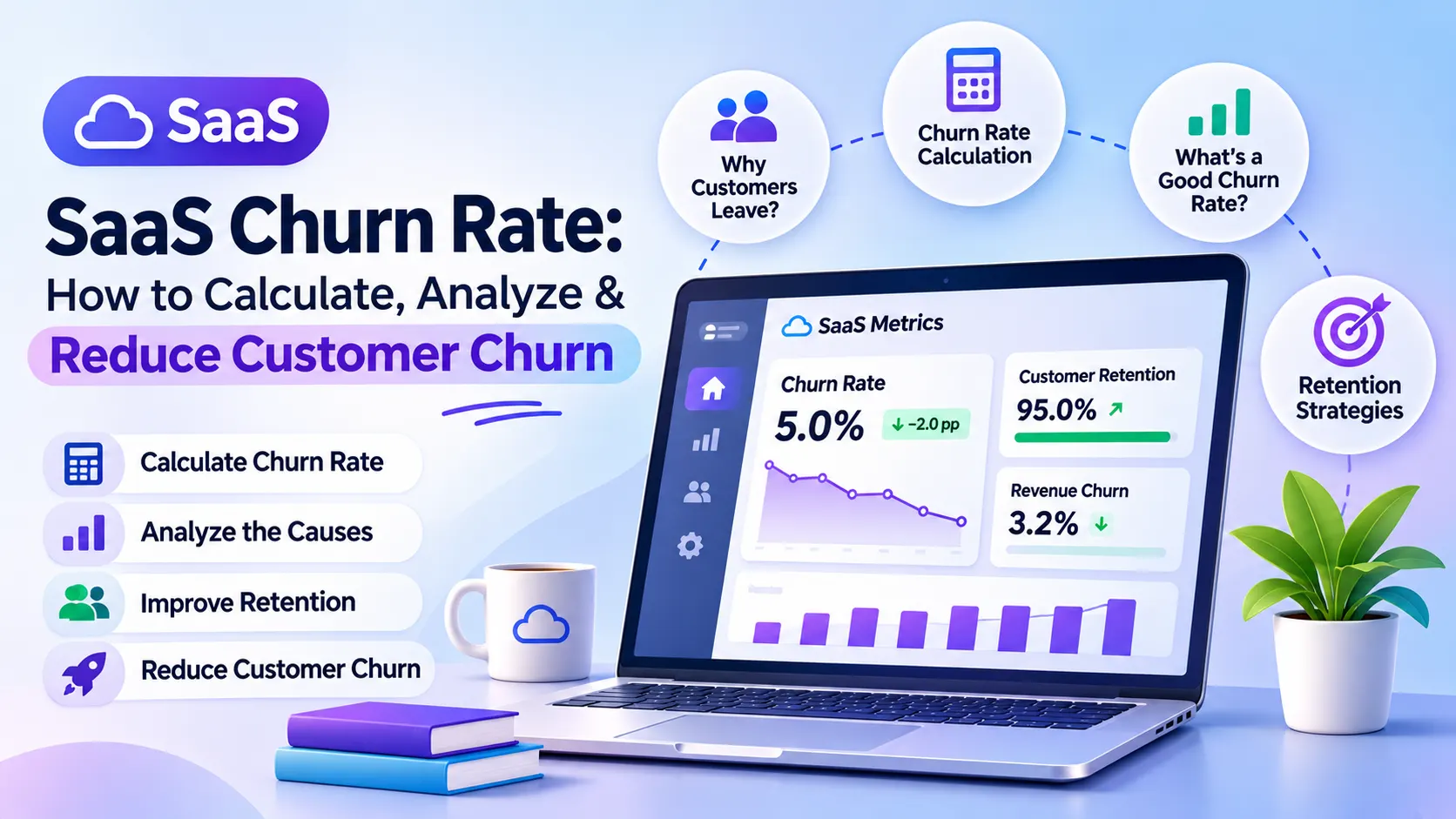
SaaS churn rate is the percentage of customers or recurring revenue a software company loses during a specific period. Customers may leave by cancelling their subscriptions, failing to renew, or discontinuing a paid service.
For example, if a SaaS company begins a month with 500 paying customers and 25 of them cancel, its monthly customer churn rate is 5%.
Churn is also known as customer attrition. It is an important business metric because subscription companies depend on customers continuing to pay over time.
Why SaaS churn rate matters
A high churn rate can create several problems:
- Recurring revenue loss: Fewer active subscribers mean less predictable subscription income.
- Higher acquisition pressure: Businesses must find new customers to replace those who leave.
- Lower customer lifetime value: Customers who leave early generate less revenue over their relationship with the company.
- Product improvement signals: Frequent cancellations may indicate usability problems, missing features, or poor product-market fit.
- Growth challenges: Acquiring customers becomes less effective when existing customers leave at a similar or faster rate.
Monitoring churn helps businesses understand whether they are building long-term customer relationships or constantly replacing lost subscribers.
Customer churn vs customer retention
Customer churn and customer retention measure opposite sides of the same relationship.
- Customer churn rate measures the percentage of customers who leave during a period.
- Customer retention rate measures the percentage of starting customers who remain during that period.
For a simple starting customer cohort, if 92% of customers remain, the customer churn rate is 8%.
Types of SaaS Churn
Understanding different types of churn helps you identify whether the problem involves customer losses, revenue losses, or payment difficulties.
1. Customer churn
Customer churn measures the percentage of customers who cancel or fail to renew their subscriptions during a defined period.
For example, if 40 out of 800 starting customers leave during a month, the customer churn rate is 5%.
2. Gross revenue churn
Gross revenue churn measures the recurring revenue lost from cancellations and downgrades. It does not include expansion revenue from existing customers.
This metric helps businesses understand how much recurring revenue disappears before considering upgrades.
3. Net revenue churn
Net revenue churn accounts for both lost revenue and additional revenue generated through upgrades or expansion by existing customers.
If expansion revenue exceeds lost recurring revenue, net revenue churn can become negative. This means the existing customer base generated more recurring revenue than it lost, even if some customers cancelled.
4. Voluntary vs involuntary churn
| Type | Meaning | Example |
|---|---|---|
| Voluntary churn | Customers deliberately cancel their subscriptions | A customer switches to a competitor |
| Involuntary churn | Customers lose access because of payment or billing problems | An expired card causes a failed renewal |
These two types need different solutions. Voluntary churn usually requires product, pricing, or customer-experience improvements. Involuntary churn often requires better payment recovery processes.
How to Calculate SaaS Churn Rate
Calculating churn is straightforward when you use a consistent time period and accurate customer records.
Customer churn rate formula
Customer Churn Rate = (Customers Lost During the Period ÷ Customers at the Beginning of the Period) × 100
Follow these steps:
- Select a period, such as a month, quarter, or year.
- Count the paying customers at the beginning of that period.
- Identify how many of those starting customers cancelled or failed to renew.
- Divide the lost customers by the starting customer count.
- Multiply the result by 100.
SaaS churn rate calculation example
Imagine a SaaS company starts April with 600 paying customers. During April, 30 of those customers cancel their subscriptions.
Using the formula:
Customer Churn Rate = (30 ÷ 600) × 100
Monthly Customer Churn Rate = 5%
This means the company lost 5% of its starting customer base during April.
Remember to use the starting customer cohort when calculating churn. New customers acquired during the month should not be added to the starting denominator. If a new customer also cancels within the same period, report that separately or use a clearly defined cohort method.
How to calculate SaaS revenue churn
Revenue churn measures lost recurring revenue rather than the number of customers.
Gross Revenue Churn Rate = (MRR Lost from Cancellations and Downgrades ÷ Starting MRR) × 100
For example:
- Starting monthly recurring revenue: ₹10,00,000
- Revenue lost from cancellations: ₹40,000
- Revenue lost from downgrades: ₹10,000
Gross Revenue Churn Rate = (₹50,000 ÷ ₹10,00,000) × 100
Gross Revenue Churn Rate = 5%
For net revenue churn, subtract expansion revenue from existing customers before dividing by starting MRR.
Net Revenue Churn Rate = [(Revenue Lost − Expansion Revenue) ÷ Starting MRR] × 100
If the company gains ₹60,000 through upgrades, its net revenue churn becomes:
[(₹50,000 − ₹60,000) ÷ ₹10,00,000] × 100 = −1%
A negative result means expansion revenue exceeded revenue losses. It does not mean that no customers cancelled.
Monthly vs annual churn
Churn rates should always be reported with their time period. A monthly churn rate cannot be compared directly with an annual churn rate.
If you want to estimate annual churn from a consistent monthly churn rate, use the compounded formula:
Annual Churn Rate = 1 − (1 − Monthly Churn Rate)¹²
For example, a 2% monthly churn rate corresponds to approximately 21.5% annual churn, assuming the same monthly rate compounds consistently.
What Is a Good Churn Rate for SaaS?
There is no single churn rate that is considered good for every SaaS business. An appropriate target depends on the customer segment, product type, pricing, contract length, and business model.
For example:
- B2C SaaS: Consumer products may experience more frequent cancellations because customers can often switch easily and make shorter-term purchasing decisions.
- Small-business SaaS: Smaller businesses may change software when budgets, operations, or business requirements change.
- Enterprise SaaS: Enterprise providers often have longer contracts, more complex implementations, and deeper customer relationships.
Rather than relying on one industry-wide number, compare your churn rate with:
- Your own historical performance.
- Similar customer segments and subscription plans.
- Your business model and contract structure.
- Your customer retention and revenue trends.
A consistently rising churn rate deserves investigation, even if the percentage appears small.
What Causes Customer Churn in SaaS?
Customers rarely leave for only one reason. Their decisions often result from several problems that build over time.
Common causes include:
1. Poor onboarding: Customers who cannot understand the software or complete initial setup may never experience its full value.
2. Poor product experience: Complicated navigation, slow performance, technical errors, or missing features can frustrate users.
3. Pricing problems: Customers may cancel when the subscription becomes too expensive compared with the value they receive.
4. Low engagement: A decline in logins, feature usage, or completed tasks can indicate that customers are losing interest.
5. Weak customer support: Slow responses and unresolved problems can damage trust.
6. Stronger competition: Customers may move to an alternative that better matches their needs or budget.
7. Changing business requirements: A company may close, change its operations, reduce its software budget, or no longer need the product.
8. Failed payments: Expired cards, insufficient funds, or billing errors can cause involuntary cancellations.
Understanding the reason behind customer loss is essential before choosing a retention strategy.
How to Analyze SaaS Churn Rate
Calculating churn tells you how many customers are leaving. Churn analysis helps you understand why.
Use these practical approaches:
1. Segment customers
Compare churn across different subscription plans, customer sizes, industries, acquisition channels, and contract types.
For example, if customers on a particular plan cancel more frequently, investigate whether its price, features, or usage limits meet their expectations.
2. Use cohort analysis
Cohort analysis groups customers according to a shared starting point, such as their signup month.
Track how many customers from each group remain after one, three, six, or twelve months. This helps reveal whether newer customers are retaining better than older groups.
3. Monitor customer engagement
Review indicators such as:
- Login frequency.
- Usage of important features.
- Number of active users.
- Completed workflows.
- Support requests.
- Onboarding progress.
A sudden decline in important product activity can indicate a customer who needs attention.
4. Collect cancellation feedback
Ask customers why they are leaving. Offer simple cancellation surveys, interviews, or feedback forms.
Group responses into categories such as price, missing features, technical problems, poor support, and changing business needs. This makes recurring issues easier to identify.
8 Customer Retention Strategies to Reduce SaaS Churn
Once you understand the causes of churn, you can take targeted action. Here are eight practical customer retention strategies.
1. Improve the onboarding experience
Help new customers reach their first meaningful result as quickly as possible. Use welcome emails, setup guides, product walkthroughs, and short tutorials.
2. Demonstrate product value regularly
Show customers how the software helps them complete tasks, save time, or improve their workflows. Product updates and usage summaries can remind customers why their subscription matters.
3. Provide responsive customer support
Make it easy to ask for help through email, live chat, or a support portal. Track unresolved issues and prioritize problems that prevent customers from using essential features.
4. Monitor at-risk customers
Identify customers with declining usage, repeated complaints, or incomplete onboarding. Contact them with relevant guidance before they decide to cancel.
5. Collect and act on customer feedback
Use surveys, interviews, and support conversations to understand customer expectations. More importantly, communicate when feedback leads to product improvements.
6. Review pricing and subscription plans
Make sure customers understand what each plan includes. Consider whether your pricing, usage limits, and upgrade options still match the value your product delivers.
7. Make payment recovery easier
Send payment failure notifications, renewal reminders, and secure card-update links. Configure appropriate payment retries so customers can resolve temporary billing problems.
8. Build long-term customer relationships
Offer relevant training, product education, customer communities, and regular account reviews. For larger B2B customers, help teams connect product usage with their business goals.
Common Churn Reduction Mistakes
Even businesses that track churn can make mistakes when trying to improve it.
- Focusing only on discounts: Lower prices will not solve poor product quality or a lack of value.
- Waiting until cancellation: Retention efforts should begin when early warning signs appear.
- Ignoring customer segments: Different customers may leave for completely different reasons.
- Measuring only customer churn: Revenue churn can reveal the financial impact of losing high-value accounts.
- Collecting feedback without action: Asking customers for opinions is ineffective if recurring problems remain unresolved.
- Ignoring involuntary churn: Payment failures can cause preventable subscription losses.
Frequently Asked Questions
1. How do you calculate SaaS churn rate?
Divide the number of starting customers who cancelled during a specific period by the number of customers at the beginning of that period. Multiply the result by 100 to get the percentage.
2. What is a good churn rate for SaaS?
There is no universal ideal churn rate. It varies according to customer type, pricing, product category, contract length, and business model. Compare your performance with similar companies and your own historical results.
3. What is the difference between customer churn and revenue churn?
Customer churn measures the percentage of customers lost during a period. Revenue churn measures the recurring revenue lost through cancellations and downgrades. A company may lose a small number of high-value customers and experience significant revenue churn.
4. What causes customer churn in SaaS?
Common causes include poor onboarding, product problems, high perceived costs, low engagement, weak customer support, competition, changing business needs, and failed payments.
5. How can SaaS companies reduce customer churn?
SaaS companies can reduce churn by improving onboarding, monitoring product usage, providing responsive support, collecting feedback, demonstrating product value, reviewing pricing, and fixing payment problems.