



Getting new customers is important for any SaaS business, but keeping them for the long term is what makes growth sustainable. A customer who subscribes for several years can generate significantly more value than someone who cancels after the first month.
This is where SaaS customer lifetime value becomes important.
Also known as CLV or LTV, this metric helps businesses estimate how much value a customer will generate throughout their relationship with the company.
Understanding it can help you make smarter decisions about customer acquisition, pricing, retention, and business growth.
In this guide, we’ll explain how to calculate SaaS CLV, understand the LTV to CAC ratio, and explore practical strategies to improve customer lifetime value.
What Is SaaS Customer Lifetime Value?
SaaS customer lifetime value (CLV) is the estimated total gross profit a subscription-based business expects to generate from a customer throughout their relationship with the company.
Unlike traditional businesses that depend on individual purchases, SaaS companies earn recurring revenue through monthly or annual subscriptions.
For example, imagine a customer paying $100 per month for project management software. If they continue subscribing for three years, they generate $3,600 in subscription revenue.
However, this amount is not the actual gross-profit-based CLV because the company also spends money on hosting, customer support, and other service delivery costs.
A more useful SaaS CLV calculation considers these costs alongside customer retention.
Why Is Customer Lifetime Value Important for SaaS?
Understanding customer lifetime value helps SaaS businesses make better financial and operational decisions.
Here are the main benefits:
- Better acquisition spending: Understand how much you can reasonably spend to acquire customers.
- Improved retention: Identify the financial impact of keeping customers longer.
- Smarter pricing: Evaluate whether subscription plans generate sustainable value.
- Customer segmentation: Discover which customer groups contribute the most long-term value.
- Sustainable growth: Compare lifetime customer value against acquisition costs.
Instead of focusing only on new signups, SaaS companies can use CLV to understand the long-term value of their customer relationships.
SaaS LTV Formula: How to Calculate Customer Lifetime Value
The most commonly used simplified SaaS LTV formula is:
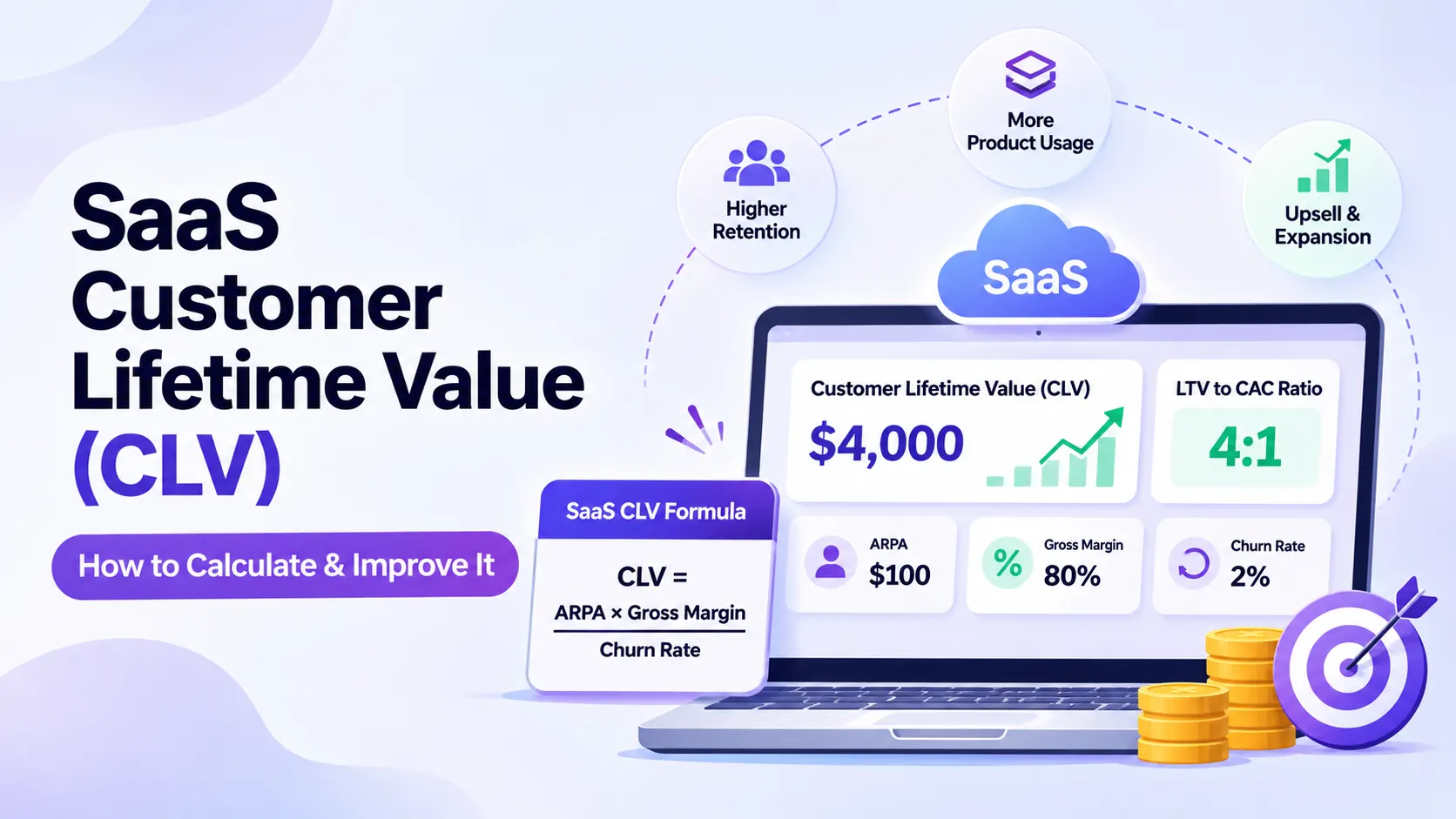
CLV = (ARPA × Gross Margin) ÷ Customer Churn Rate
Let’s understand each component.
1. Average Revenue Per Account (ARPA)
ARPA represents the average recurring revenue generated by each paying customer account.
Formula:
ARPA = Monthly Recurring Revenue ÷ Number of Paying Accounts
For example, if your SaaS business generates $20,000 in monthly recurring revenue from 200 accounts:
ARPA = $20,000 ÷ 200 = $100
2. Gross Margin
Gross margin represents the percentage of revenue remaining after subtracting the direct costs of delivering your service.
These costs may include hosting, third-party software services, and relevant customer support expenses.
Formula:
Gross Margin = [(Revenue − Cost of Services) ÷ Revenue] × 100
If your business generates $20,000 and spends $4,000 delivering its services, your gross margin is 80%.
3. Customer Churn Rate
Customer churn rate measures the percentage of customers lost during a particular period.
Formula:
Customer Churn Rate = (Customers Lost ÷ Customers at Start) × 100
If you begin a month with 200 customers and lose four, your monthly churn rate is 2%.
For a basic account-level CLV estimate, use customer churn rather than net revenue churn.
SaaS Customer Lifetime Value Calculation Example
Let’s calculate SaaS CLV using a hypothetical subscription business.
Suppose your company has:
| Metric | Value |
|---|---|
| Monthly recurring revenue | $20,000 |
| Paying customer accounts | 200 |
| Average revenue per account | $100 |
| Gross margin | 80% |
| Monthly customer churn rate | 2% |
Step 1: Calculate monthly gross profit per account
$100 × 0.80 = $80
Step 2: Estimate average customer lifetime
1 ÷ 0.02 = 50 months
Step 3: Calculate customer lifetime value
CLV = $80 ÷ 0.02
CLV = $4,000
This means the business expects approximately $4,000 in gross profit from an average customer over their estimated lifetime, assuming revenue, margins, and churn remain stable.
The result is a planning estimate, not a guarantee.
What Is the LTV to CAC Ratio?
The LTV to CAC ratio compares customer lifetime value with the cost of acquiring a new customer.
CAC stands for Customer Acquisition Cost. It typically includes relevant marketing and sales expenses divided by the number of customers acquired.
Formula:
LTV to CAC Ratio = Customer Lifetime Value ÷ Customer Acquisition Cost
For example:
- Customer lifetime value: $4,000
- Customer acquisition cost: $1,000
LTV to CAC = $4,000 ÷ $1,000 = 4:1
This means the business expects to generate $4 in lifetime gross profit for every $1 spent acquiring a customer.
What Is a Good LTV to CAC Ratio?
A ratio of approximately 3:1 is a commonly cited SaaS planning benchmark, but it is not a universal requirement.
| Ratio | General interpretation |
|---|---|
| Below 1:1 | Lifetime gross profit is lower than acquisition cost |
| 1:1–3:1 | Review acquisition efficiency and profitability |
| Around 3:1 | Common planning target |
| Above 5:1 | Strong modeled returns; investigate potential growth investment opportunities |
The right ratio depends on your pricing, margins, customer segment, growth stage, and cash flow.
How to Increase SaaS LTV: 7 Effective Strategies
Improving SaaS customer lifetime value requires more than increasing subscription prices. Businesses must also focus on customer experience, retention, and service efficiency.
1. Reduce Customer Churn
Churn directly affects the estimated lifetime of your customers.
Identify why customers cancel subscriptions through feedback surveys, support conversations, and product usage data.
Address recurring problems such as confusing interfaces, missing features, and poor support.
Even modest improvements in retention can increase modeled CLV significantly.
2. Improve Customer Onboarding
Customers are more likely to continue using software when they understand its value.
Create a structured onboarding experience with welcome emails, setup guides, tutorials, and product walkthroughs.
Help users achieve their first meaningful result quickly instead of overwhelming them with every feature.
3. Increase Product Adoption
Customers who regularly use valuable features have more reasons to maintain their subscriptions.
Track feature adoption and introduce relevant functionality through tutorials, personalized recommendations, and educational resources.
Focus on helping customers achieve their goals rather than simply increasing login frequency.
4. Encourage Upselling and Cross-Selling
Offer customers opportunities to upgrade when they need additional functionality.
For example, a project management platform might provide advanced reporting, automation, or additional team seats through higher subscription plans.
Relevant upgrades can increase average revenue per account and customer lifetime value.
5. Optimize SaaS Pricing
Review your pricing plans regularly to ensure they reflect the value customers receive.
Consider tiered subscriptions, usage-based pricing, or additional feature packages where appropriate.
Avoid unnecessary price increases that could reduce retention.
6. Provide Proactive Customer Support
Don’t wait until customers decide to cancel.
Monitor warning signs such as declining product usage, unresolved support tickets, and repeated technical problems.
Reach out with relevant assistance before these issues affect customer satisfaction.
7. Improve Gross Margins
Increasing revenue is not the only way to improve CLV.
Review hosting expenses, third-party API costs, and support processes to identify opportunities for greater efficiency.
Reducing unnecessary service delivery costs while maintaining product quality can improve gross profit per customer.
SaaS Customer Lifetime Value Calculator
You can create a simple SaaS customer lifetime value calculator in Excel or Google Sheets.
Enter these values:
| Input | Example |
|---|---|
| Monthly ARPA | $100 |
| Gross margin | 80% |
| Monthly churn rate | 2% |
| Calculated CLV | $4,000 |
Excel formula:
=IFERROR((B2*B3)/B4,"")
Enter ARPA in B2, gross margin in B3, and churn rate in B4. Format B3 and B4 as percentages.
This calculation assumes a stable customer churn rate and average revenue. More advanced models can incorporate customer cohorts, expansion revenue, and changing costs.
Common SaaS CLV Calculation Mistakes
Avoid these mistakes when measuring customer lifetime value:
- Ignoring gross margin: Revenue-based calculations can overstate the value available to cover acquisition expenses.
- Mixing time periods: Monthly ARPA must be paired with monthly churn, not annual churn.
- Using one average for every customer: Different customer segments may have significantly different retention and profitability.
- Ignoring expansion revenue: Upgrades and additional usage can increase future customer value.
- Assuming churn never changes: The simplified formula becomes less reliable when customer behavior changes significantly.
- Confusing CLV with net profit: Gross-profit-based CLV does not deduct every operating expense or acquisition cost.
Final Thoughts
SaaS customer lifetime value is an important metric for understanding the long-term financial value of customer relationships.
By combining average revenue per account, gross margin, and customer churn, businesses can estimate how much value customers may generate over time.
However, calculating CLV is only the beginning. Improving retention, onboarding, product adoption, pricing, and service efficiency can help increase customer value.
Track CLV alongside acquisition costs and customer retention metrics to make better decisions and build a more sustainable SaaS business.
Frequently Asked Questions
What is SaaS customer lifetime value?
SaaS customer lifetime value is the estimated total gross profit a business expects to earn from a customer throughout their subscription relationship.
How do you calculate SaaS LTV?
A common formula is CLV = (Average Revenue Per Account × Gross Margin) ÷ Customer Churn Rate, using consistent measurement periods.
What is a good SaaS LTV to CAC ratio?
A 3:1 ratio is a commonly used planning benchmark, although the ideal ratio varies depending on the company’s business model, growth stage, and financial performance.
How can SaaS companies increase customer lifetime value?
They can improve customer retention, simplify onboarding, encourage product adoption, offer relevant upgrades, optimize pricing, and reduce service delivery costs.
Is SaaS CLV the same as LTV?
Yes. CLV and LTV are commonly used interchangeably in SaaS to describe customer lifetime value.