



Getting customers to sign up for your SaaS product is only the first step. The real challenge is helping them understand how it works, experience its value, and use it regularly.
This is where SaaS Customer Onboarding plays an important role. A well-planned onboarding experience guides new users through setup, introduces essential features, and helps them achieve their first meaningful result.
Without proper guidance, customers may struggle with the product, lose interest, or cancel their subscriptions. In this guide, we’ll explore the SaaS customer onboarding process, effective practices, useful tools, and a checklist to improve user activation and retention.
What Is SaaS Customer Onboarding?
SaaS customer onboarding is the process of guiding new users through a software product so they can understand its features, complete the initial setup, and achieve their goals.
For example, someone signing up for a project management tool may need to create a workspace, invite team members, create a project, and assign tasks.
A good onboarding experience makes these steps simple through tutorials, welcome emails, product tours, and customer support.
The goal is not just to teach users how the software works. It is to help them experience its value as quickly as possible.
Why Is Customer Onboarding Important for SaaS?
An effective onboarding experience can improve the relationship between a SaaS company and its customers.
Here are its main benefits:
- Improves user activation: Helps customers complete important actions and experience the product’s core value.
- Reduces early churn: Addresses confusion and setup problems before users lose interest.
- Increases product adoption: Encourages customers to explore useful features.
- Builds customer confidence: Makes users comfortable with the software through clear instructions and support.
- Supports retention: Helps customers develop regular product usage habits.
Understanding the SaaS Customer Onboarding Process
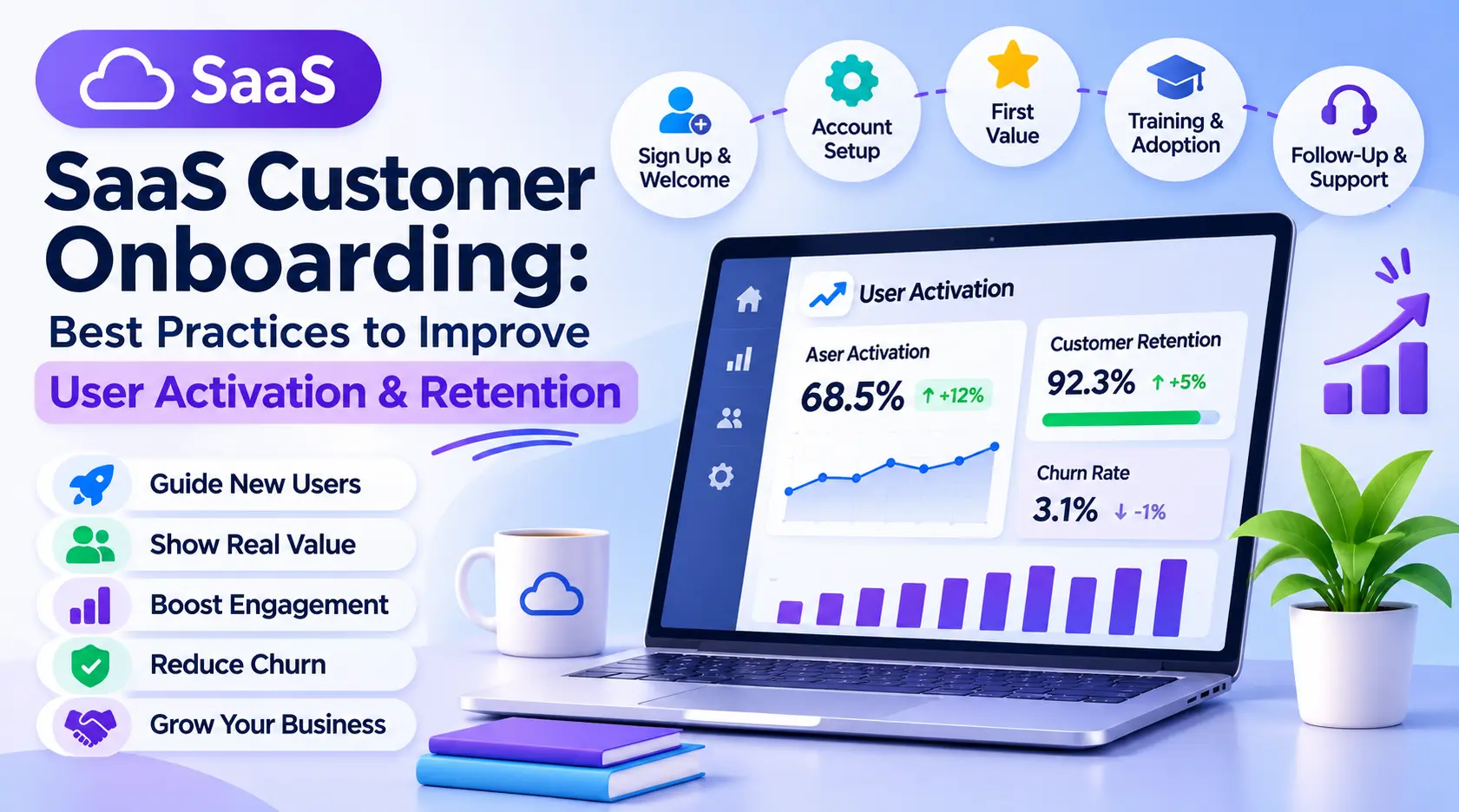
A structured SaaS customer onboarding process should guide users through these five stages.
1. Signup and Welcome
Start with a simple registration process and a personalized welcome email. Explain what users should do next and provide a clear starting point.
2. Account Setup
Help customers configure their accounts, connect integrations, import data, and invite team members. Use setup guides and progress indicators to make the process easier.
3. First Value and Activation
Help users complete an important action that demonstrates your product’s value.
For example, a CRM user might add their first lead, while an email marketing user might send their first campaign. This important milestone is often called the aha moment.
4. Training and Feature Adoption
Introduce relevant features through interactive product tours, short videos, tutorials, and knowledge base articles. Avoid overwhelming users with too much information at once.
5. Follow-Up and Support
Check whether customers are achieving their goals. Send helpful reminders, collect feedback, and provide assistance when users experience difficulties.
10 SaaS Customer Onboarding Best Practices
Use these practices to create a smoother onboarding experience and improve product adoption.
1. Understand Customer Goals
Identify why customers chose your software. Use signup questions, surveys, or sales conversations to understand their needs and recommend relevant features.
2. Keep the Process Simple
Avoid lengthy forms and unnecessary setup steps. Break onboarding into smaller tasks and guide users through one important action at a time.
3. Personalize the Experience
Different customers have different requirements. Customize onboarding based on their role, experience, industry, and primary use case.
4. Deliver Value Early
Identify the main action that demonstrates your product’s benefits. Use templates, sample data, and guided workflows to help customers reach that milestone quickly.
5. Use Interactive Product Tours
Show users how to complete important tasks directly inside your platform. Keep tours short and allow users to revisit instructions whenever needed.
6. Combine Automation With Human Support
Automate welcome emails, setup reminders, and tutorial recommendations. Offer personal assistance for complex issues and technical problems.
This balance helps businesses provide effective customer onboarding support for SaaS products without losing the personal touch.
7. Provide Educational Resources
Create helpful resources such as getting-started guides, video tutorials, FAQs, and troubleshooting articles. Make them easy to access whenever customers need assistance.
8. Collect Customer Feedback
Ask users about their onboarding experience. Find out which steps were confusing and what additional guidance they need. Use this feedback to improve your process.
9. Track Onboarding Progress
Monitor how users move through onboarding. If customers repeatedly abandon the same step, investigate the problem and make that part of the experience easier.
10. Continue Supporting Customers
Onboarding should not end after the first successful action. Share relevant feature updates, advanced tutorials, and helpful recommendations to encourage continued product usage.
SaaS Customer Onboarding Models
The right onboarding approach depends on product complexity, customer needs, and available resources.
Self-Service Onboarding: Customers explore the product independently using tutorials, automated emails, guides, and in-app instructions. It works well for simple SaaS products.
Low-Touch Onboarding: Combines automated guidance with occasional human assistance, such as optional onboarding calls or customer check-ins.
High-Touch Onboarding: Provides personalized support through onboarding specialists or customer success managers. It is suitable for complex software and enterprise customers.
SaaS Customer Onboarding Process Flow
A simple onboarding process flow can help your team manage each stage consistently:
Signup → Welcome Email → Goal Identification → Account Setup → Product Walkthrough → First Value → Training → Follow-Up → Regular Product Usage
Each stage should have a clear objective. For example, account setup prepares users to work with the software, while the first-value stage helps them experience its main benefit.
How to Measure SaaS Customer Onboarding Success
Tracking the right metrics helps you identify problems and improve the onboarding experience.
1. Onboarding Completion Rate
Measures how many users complete the defined onboarding steps.
Formula:
Onboarding Completion Rate = (Users Who Completed Onboarding ÷ Users Who Started Onboarding) × 100
2. Time to First Value (TTFV)
Measures how long it takes customers to experience the first meaningful benefit of your product.
3. User Activation Rate
Measures the percentage of new users who complete a predefined value-generating action.
Formula:
Activation Rate = (Users Who Complete the Activation Action ÷ Total New Users) × 100
4. Feature Adoption Rate
Shows how many customers use important product features and helps identify which features need better guidance.
5. Customer Satisfaction Score
Collects feedback about the onboarding experience through short customer surveys.
6. Customer Churn Rate
Tracks how many customers cancel their subscriptions during or shortly after onboarding. A high early churn rate may indicate problems with setup, expectations, or product understanding.
SaaS Customer Onboarding Checklist
Use this checklist to organize your onboarding activities.
Before onboarding
- Identify customer goals and requirements.
- Understand their primary use case.
- Prepare account details and resources.
- Assign an onboarding owner if needed.
During onboarding
- Send a welcome email.
- Guide users through account setup.
- Provide a product walkthrough.
- Help users complete their first important action.
- Share tutorials and documentation.
- Offer support when needed.
After activation
- Follow up with customers.
- Collect feedback.
- Monitor product usage.
- Identify inactive users.
- Recommend relevant features.
- Review onboarding performance.
You can turn this into a reusable SaaS customer onboarding checklist template for your team.
SaaS Customer Onboarding Templates and Software
Templates and specialized tools can make onboarding easier to manage.
Useful SaaS customer onboarding templates include:
- Welcome email template: Introduces the product and explains the next steps.
- Onboarding checklist template: Lists tasks for customers and internal teams.
- Onboarding survey template: Collects customer goals and feedback.
- Kickoff meeting template: Defines objectives, responsibilities, and timelines.
- Customer onboarding plan template: Organizes the complete customer journey.
When selecting SaaS customer onboarding software, look for automated workflows, in-app product tours, progress tracking, customer segmentation, product analytics, and CRM integrations.
Choose tools according to your actual requirements rather than adding unnecessary complexity.
Common Onboarding Mistakes to Avoid
Avoid these mistakes when onboarding SaaS customers:
- Overloading users: Introducing too many features at once can create confusion.
- Complicated setup: Unnecessary forms and configuration steps can discourage users.
- Ignoring customer needs: A single onboarding journey may not suit every user.
- Relying only on automation: Customers should have access to human support when necessary.
- Ignoring performance metrics: Without tracking activation and completion, it is difficult to identify problems.
- Stopping too early: Customers need continued guidance after their first successful action.
A well-designed onboarding strategy can help SaaS businesses build stronger customer relationships, improve product adoption, and support long-term retention.
Frequently Asked Questions
1. What is SaaS customer onboarding?
It is the process of guiding new users through a software product so they can understand its features, complete setup, and achieve meaningful results.
2. Why is customer onboarding important for SaaS?
It helps users experience product value, understand important features, overcome setup difficulties, and develop regular usage habits.
3. What are the main stages of SaaS onboarding?
The main stages include signup, welcome communication, account setup, first value, product training, and follow-up support.
4. How long should SaaS customer onboarding take?
It depends on product complexity. Simple tools may help users experience value within minutes, while enterprise platforms may require several days or weeks.
5. What is the difference between onboarding and user activation?
Onboarding is the complete process of guiding users through a product. Activation happens when users complete an important action and experience its core value.
6. Which metrics should SaaS companies track?
Important metrics include onboarding completion rate, time to first value, activation rate, feature adoption, customer satisfaction, and churn rate.