





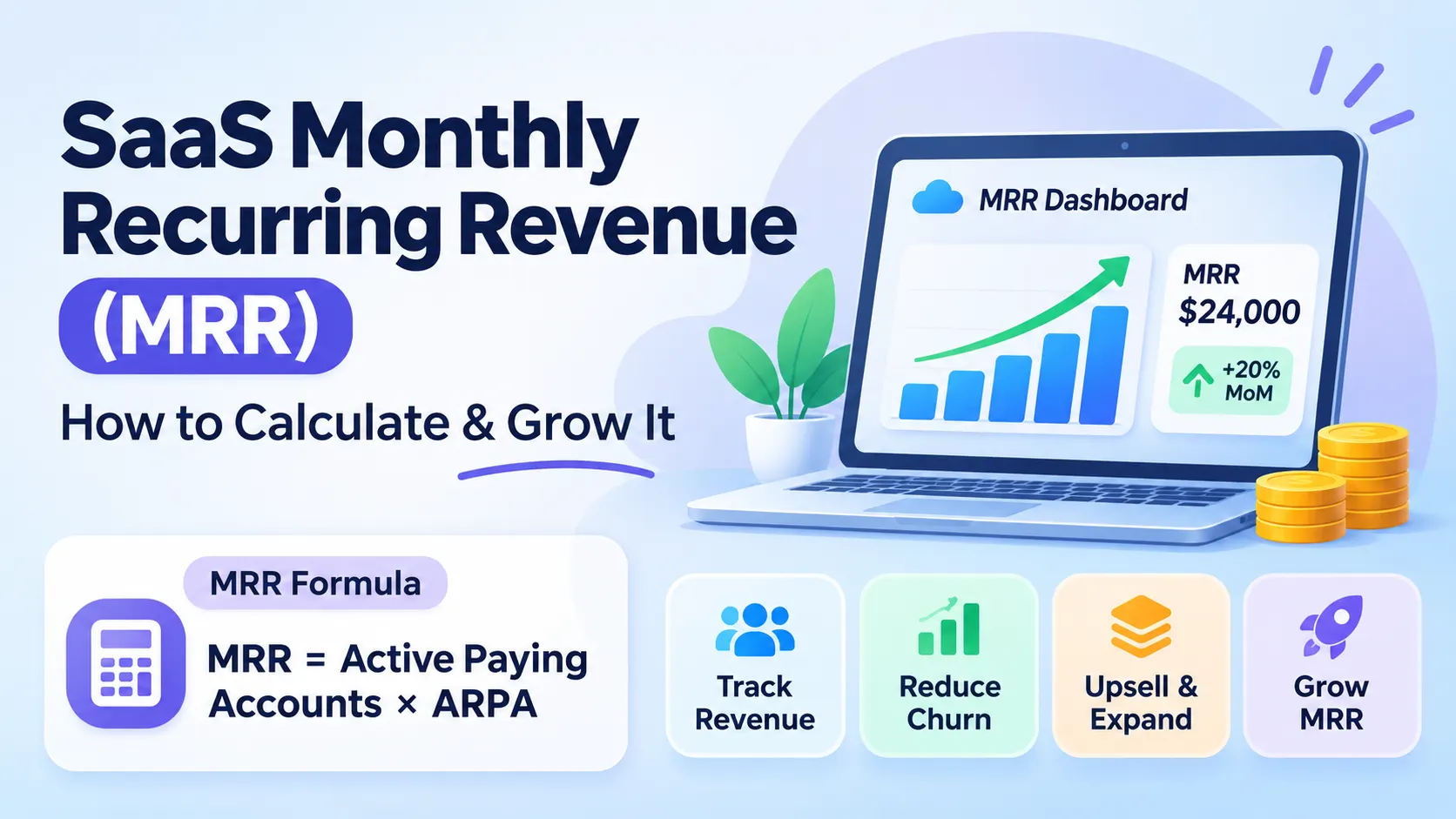
Running a successful SaaS business requires more than attracting new customers. You also need a reliable way to understand how much revenue your subscriptions generate and whether your business is growing consistently.
This is where SaaS monthly recurring revenue (MRR) becomes important. It helps businesses measure recurring subscription revenue, monitor financial performance, and identify growth opportunities.
Whether you’re launching a SaaS startup or managing an established subscription business, understanding MRR can help you make better decisions about pricing, customer retention, and revenue growth.
In this guide, we’ll explain how to calculate MRR, explore its different types, and discuss practical strategies to increase recurring revenue.
What Is Monthly Recurring Revenue in SaaS?
SaaS monthly recurring revenue (MRR) is the normalized monthly revenue generated by a company’s active recurring subscriptions.
Unlike one-time sales, MRR focuses on revenue that is expected to repeat through ongoing customer subscriptions.
For example, if a SaaS company has 200 paying customers, each subscribing for $50 per month, its MRR is $10,000.
MRR excludes one-time setup fees, installation charges, consulting fees, and other non-recurring payments.
It is an operational performance metric rather than a measure of recognized accounting revenue or actual cash collected.
Why Is MRR Important for SaaS Businesses?
Tracking SaaS MRR helps businesses understand their financial stability and growth potential.
The main benefits include:
- Revenue forecasting: Establish a baseline for future subscription revenue.
- Financial planning: Make informed budgeting, hiring, and investment decisions.
- Growth measurement: Monitor whether recurring revenue is increasing or declining.
- Customer retention: Understand the financial impact of cancellations and downgrades.
- Investor reporting: Demonstrate recurring revenue performance and business momentum.
- Pricing optimization: Evaluate the effectiveness of subscription plans.
Monitoring MRR alongside customer acquisition cost, customer lifetime value, and churn provides a more complete picture of business health.
How to Calculate MRR in SaaS
The basic monthly recurring revenue formula is:
MRR = Active Paying Accounts × Average Monthly Revenue Per Account (ARPA)
For example:
- Active paying accounts: 250
- Average monthly revenue per account: $40
MRR = 250 × $40
Total MRR = $10,000
However, SaaS companies often offer different subscription plans and billing cycles. In these situations, calculate the monthly equivalent of each active subscription and add them together.
Calculating MRR for Different Billing Cycles
| Billing Cycle | Subscription Value | Monthly Equivalent |
|---|---|---|
| Monthly | $100 | $100 |
| Quarterly | $300 | $100 |
| Semi-annual | $600 | $100 |
| Annual | $1,200 | $100 |
| Two-year | $2,400 | $100 |
Divide the recurring subscription value by the number of months it covers.
This ensures that annual or quarterly payments do not artificially inflate monthly recurring revenue.
6 Types of Monthly Recurring Revenue
Understanding different MRR components helps businesses identify where recurring revenue growth and losses originate.
1. New MRR
Recurring revenue generated from newly acquired paying customers.
For example, 20 new customers subscribing at $50 per month generate $1,000 in new MRR.
2. Expansion MRR
Additional recurring revenue generated from existing customers through upgrades, additional seats, or paid add-ons.
3. Contraction MRR
Recurring revenue lost when existing customers downgrade their subscriptions or reduce their paid usage.
4. Churned MRR
Recurring revenue lost when customers completely cancel their subscriptions.
5. Reactivation MRR
Recurring revenue recovered when previously canceled customers return and purchase a subscription.
6. Net New MRR
The overall change in monthly recurring revenue after accounting for revenue gains and losses.
Net New MRR = New MRR + Expansion MRR + Reactivation MRR − Contraction MRR − Churned MRR
A positive net new MRR indicates recurring revenue growth, while a negative result indicates a decline.
SaaS MRR Calculation Example
Imagine a SaaS company starts November with $20,000 in monthly recurring revenue.
During the month, it experiences the following changes:
| Revenue Component | Amount |
|---|---|
| Starting MRR | $20,000 |
| New MRR | +$3,000 |
| Expansion MRR | +$1,500 |
| Reactivation MRR | +$500 |
| Contraction MRR | −$400 |
| Churned MRR | −$600 |
| Net New MRR | $4,000 |
| Ending MRR | $24,000 |
Net New MRR = $3,000 + $1,500 + $500 − $400 − $600
Net New MRR = $4,000
Ending MRR = Starting MRR + Net New MRR
Ending MRR = $24,000
This calculation helps businesses understand not only how much recurring revenue they have but also what contributed to its growth.
MRR vs ARR: Key Differences
Monthly Recurring Revenue (MRR) and Annual Recurring Revenue (ARR) both measure recurring subscription revenue but express it over different periods.
| Feature | MRR | ARR |
|---|---|---|
| Full form | Monthly Recurring Revenue | Annual Recurring Revenue |
| Time frame | Monthly | Annual |
| Primary purpose | Short-term performance tracking | Long-term revenue planning |
| Calculation | Monthly recurring subscription value | MRR × 12 |
| Common use | Monthly growth monitoring | Annual planning and reporting |
For example, if your SaaS business has an MRR of $24,000:
ARR = $24,000 × 12
ARR = $288,000
This represents an annualized revenue run rate, assuming the current subscription base remains unchanged. It is not guaranteed future revenue.
How to Calculate SaaS MRR Growth Rate
The SaaS MRR growth rate measures the percentage change in monthly recurring revenue between two consecutive months.
MRR Growth Rate = [(Current MRR − Previous MRR) ÷ Previous MRR] × 100
Using the previous example:
- Previous MRR: $20,000
- Current MRR: $24,000
MRR Growth Rate = [($24,000 − $20,000) ÷ $20,000] × 100
MRR Growth Rate = 20%
This means the company’s recurring revenue increased by 20% during the month.
Tracking this metric consistently helps businesses evaluate revenue momentum and identify potential problems.
SaaS MRR Benchmarks: What Is a Good Growth Rate?
There is no universal MRR growth benchmark for every SaaS business. Growth expectations depend on company size, market demand, pricing, customer segments, and business maturity.
Early-stage startups may experience higher percentage growth because they start with a smaller revenue base. Established SaaS companies may grow more slowly while generating substantially more additional revenue.
When evaluating SaaS MRR benchmarks, consider:
- Month-over-month MRR growth.
- Net new MRR.
- Customer churn rate.
- Net revenue retention.
- Customer acquisition cost.
- Customer lifetime value.
Consistent recurring revenue growth supported by healthy retention and sustainable acquisition expenses is generally more meaningful than achieving a particular growth percentage.
How to Increase MRR: 7 Effective Strategies
1. Reduce Customer Churn
Identify why customers cancel subscriptions through feedback surveys, support interactions, and product usage data.
Addressing recurring customer problems can protect existing subscription revenue and improve retention.
2. Improve Customer Onboarding
Help new customers understand your product through guided walkthroughs, tutorials, and personalized onboarding.
Customers who experience meaningful product value early may be more likely to continue their subscriptions.
3. Encourage Upselling and Cross-Selling
Offer relevant premium features, additional user seats, and complementary subscription products.
These opportunities can increase expansion MRR without requiring an entirely new customer acquisition process.
4. Optimize SaaS Pricing Models
Review subscription plans regularly to ensure pricing reflects the value customers receive.
Consider tiered pricing, usage-based plans, or recurring feature packages where appropriate.
5. Improve Customer Acquisition
Invest in SEO, content marketing, referral programs, and targeted advertising to attract qualified prospects.
Focus on acquisition channels that generate valuable customers at sustainable costs.
6. Recover Failed Subscription Payments
Use automated payment reminders, authorized payment retries, and billing notifications to help customers resolve payment issues.
This can reduce involuntary churn and protect recurring revenue.
7. Reactivate Former Customers
Reconnect with previously canceled customers through personalized emails, relevant product updates, or suitable subscription offers.
Winning back former customers can create additional reactivation MRR.
Monthly Recurring Revenue Calculator
You can create a simple monthly recurring revenue calculator using Excel or Google Sheets.
| Input | Example |
|---|---|
| Starting MRR (B2) | $20,000 |
| New MRR (B3) | $3,000 |
| Expansion MRR (B4) | $1,500 |
| Reactivation MRR (B5) | $500 |
| Contraction MRR (B6) | $400 |
| Churned MRR (B7) | $600 |
| Ending MRR (B8) | $24,000 |
Excel formula for ending MRR:
=B2+B3+B4+B5-B6-B7
Excel formula for MRR growth rate:
=IFERROR((B8-B2)/B2,"")
Format the growth rate cell as a percentage.
Update these values every month to monitor recurring revenue performance.
Common SaaS MRR Calculation Mistakes
Avoid these common mistakes when measuring MRR:
- Including free trial users as paying customers.
- Counting one-time setup or consulting fees.
- Including annual subscription payments at their full value.
- Ignoring discounts and subscription downgrades.
- Confusing net new MRR with total MRR.
- Treating MRR as actual cash collected.
- Ignoring currency conversion differences.
Use consistent reporting rules to maintain accurate and comparable monthly results.
Final Thoughts
SaaS monthly recurring revenue is an essential metric for understanding subscription revenue, financial stability, and business growth.
By accurately calculating MRR and monitoring its different components, businesses can identify revenue opportunities and address customer retention challenges.
Focus on delivering consistent customer value, improving onboarding, optimizing pricing, and acquiring customers efficiently to build sustainable recurring revenue over time.
Frequently Asked Questions
What does MRR mean in SaaS?
MRR stands for Monthly Recurring Revenue. It measures the normalized monthly revenue generated by active recurring subscriptions.
How do you calculate SaaS MRR?
Multiply active paying accounts by their average monthly recurring revenue, or add the monthly equivalent of each active subscription.
What is the difference between MRR and ARR?
MRR measures recurring revenue on a monthly basis, while ARR expresses recurring revenue on an annualized basis.
Does MRR include one-time payments?
No. MRR excludes non-recurring payments such as setup charges, installation fees, and one-time consulting services.
How can SaaS companies increase MRR?
They can reduce churn, improve customer acquisition, encourage subscription upgrades, optimize pricing, and recover failed payments.
What is a good MRR growth rate for SaaS?
A good growth rate depends on business maturity, customer segments, retention, and market conditions. Consistent and sustainable growth is more important than a universal percentage.