




Acquiring new customers is essential for growing a SaaS business, but spending too much to attract them can make growth difficult to sustain. Even a company with increasing subscriptions can struggle financially if its acquisition expenses are too high.
This is where SaaS customer acquisition cost (CAC) becomes important. It helps businesses understand how much they spend to acquire paying customers and whether their sales and marketing strategies are financially sustainable.
In this guide, we’ll explain how to calculate SaaS CAC, explore industry benchmarks, understand the CAC payback period, and discover practical ways to reduce acquisition costs.
What Is SaaS Customer Acquisition Cost?
is the average amount a software-as-a-service company spends to acquire one new paying customer.
It includes relevant advertising, marketing, sales, employee, and technology expenses associated with converting prospects into customers.
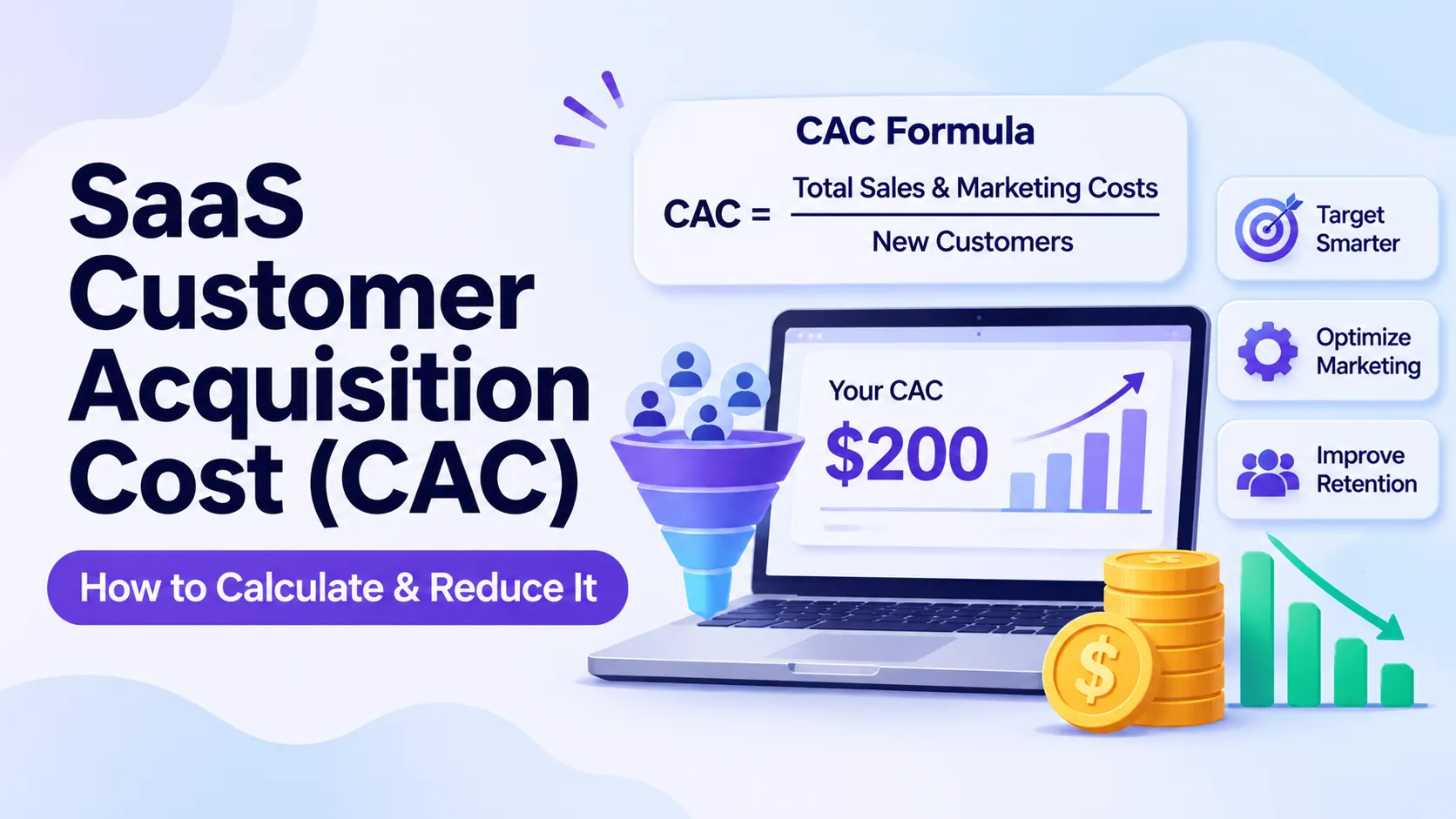
For example, if a SaaS company spends $10,000 acquiring 50 paying customers, its average customer acquisition cost is $200.
Unlike traditional businesses, SaaS companies often recover their acquisition expenses gradually through recurring subscription revenue. This makes customer retention and acquisition efficiency particularly important.
Why Is CAC Important for SaaS Businesses?
Tracking SaaS CAC helps businesses understand whether their growth strategies are effective and financially sustainable.
The main benefits include:
- Better budget allocation: Identify which marketing channels deliver cost-effective results.
- Improved profitability: Understand whether customer value justifies acquisition expenses.
- Marketing efficiency: Identify underperforming campaigns and sales activities.
- Financial forecasting: Estimate the investment required to achieve growth targets.
- Sustainable growth: Balance customer acquisition with long-term revenue.
Monitoring CAC alongside customer lifetime value and churn provides a clearer picture of business performance.
SaaS CAC Formula: How to Calculate Customer Acquisition Cost
The standard SaaS CAC formula is:
CAC = Total Sales and Marketing Acquisition Costs ÷ Number of New Paying Customers
Follow these three steps to calculate it accurately.
Step 1: Calculate Total Acquisition Expenses
Include relevant expenses associated with acquiring new customers, such as:
- Paid advertising campaigns
- Sales and marketing salaries
- Sales commissions
- SEO and content marketing
- CRM and marketing automation tools
- Agency and freelancer fees
- Events, webinars, and promotional activities
Exclude unrelated product development, service delivery, and post-sale customer support expenses. Allocate shared expenses according to their contribution to new customer acquisition.
Step 2: Count New Paying Customers
Determine how many new customers purchased a subscription during the selected period.
Do not include free trial users, unconverted leads, or existing customers who upgraded their subscriptions.
Step 3: Divide Expenses by New Customers
Divide total acquisition expenses by the number of new paying customers.
Use consistent reporting periods. For businesses with longer sales cycles, consider the delay between marketing spending and customer conversion.
SaaS Customer Acquisition Cost Calculation Example
Imagine a SaaS company has the following monthly acquisition expenses:
| Acquisition Expense | Monthly Cost |
|---|---|
| Paid advertising | $8,000 |
| Sales team expenses | $6,000 |
| Marketing team expenses | $4,000 |
| Software and CRM tools | $1,000 |
| Content marketing and SEO | $1,000 |
| Total acquisition expenses | $20,000 |
| New paying customers | 100 |
Using the CAC formula:
CAC = $20,000 ÷ 100
SaaS CAC = $200 per customer
This means the company spends an average of $200 to acquire each new paying customer.
Whether this amount is sustainable depends on customer lifetime value, gross margin, and retention.
Types of Customer Acquisition Cost in SaaS
Businesses can measure CAC in different ways depending on their objectives.
| CAC Type | Description |
|---|---|
| Paid CAC | Acquisition cost associated with paid marketing channels |
| Organic CAC | Acquisition cost associated with SEO, content, and other organic channels |
| Blended CAC | Average acquisition cost across paid and organic channels |
| Fully Loaded CAC | Includes all relevant direct and allocated indirect acquisition expenses |
Organic acquisition is not necessarily free because it involves employee time, content production, and software expenses.
SaaS CAC Benchmarks: What Is a Good CAC?
There is no universal customer acquisition cost that works for every SaaS company. Acquisition expenses vary depending on industry, customer type, subscription pricing, competition, and sales complexity.
According to First Page Sage’s November 2026 report, the average customer acquisition cost for SaaS across its analyzed industries was:
| Customer Type | Average CAC |
|---|---|
| Consumer | $213 |
| Small and Medium Businesses (SMB) | $641 |
| Middle Market | $3,232 |
| Enterprise | $7,882 |
Enterprise SaaS companies generally have higher acquisition expenses because they often require longer sales cycles, personalized demonstrations, and dedicated sales teams.
These figures represent the report’s dataset rather than universal industry targets. Businesses should compare CAC with similar customer segments and business models.
Understanding the SaaS LTV to CAC Ratio
The SaaS LTV to CAC ratio compares customer lifetime value with customer acquisition cost.
Customer lifetime value (LTV) estimates the gross profit a customer generates throughout their relationship with a business.
LTV to CAC Ratio = Customer Lifetime Value ÷ Customer Acquisition Cost
For example:
- Customer lifetime value: $800
- Customer acquisition cost: $200
LTV to CAC Ratio = $800 ÷ $200 = 4:1
| LTV:CAC Ratio | General Interpretation |
|---|---|
| Below 1:1 | Acquisition costs exceed estimated lifetime gross profit |
| 1:1–2:1 | Limited room to cover other business expenses |
| Around 3:1 | Common SaaS planning benchmark |
| 4:1–5:1 | Potentially strong acquisition efficiency |
| Above 5:1 | Possible opportunity to invest more in growth |
A 3:1 ratio is a commonly used benchmark, but the ideal ratio depends on business maturity, cash flow, and growth objectives.
What Is the SaaS CAC Payback Period?
The SaaS CAC payback period measures how long it takes a business to recover customer acquisition expenses through gross profit.
CAC Payback Period = CAC ÷ (Monthly Revenue per Customer × Gross Margin)
For example:
- Customer acquisition cost: $200
- Monthly subscription revenue: $50
- Gross margin: 80%
Payback Period = $200 ÷ ($50 × 0.80)
CAC Payback Period = 5 months
This means the business needs approximately five months to recover its acquisition investment, assuming revenue and margins remain stable.
A shorter payback period generally improves cash flow. However, enterprise SaaS businesses may operate successfully with longer payback periods when retention and contract values justify the investment.
How to Reduce Customer Acquisition Cost: 7 Effective Strategies
1. Invest in SEO and Content Marketing
Publish valuable articles, comparison guides, tutorials, and educational resources that address your target audience’s problems.
A strong organic marketing strategy can generate qualified leads over time and reduce dependence on paid advertising.
2. Improve Audience Targeting
Identify your ideal customer profile based on industry, company size, budget, and product requirements.
Targeting relevant prospects helps reduce wasted marketing spending and improve conversion rates.
3. Optimize Your Conversion Funnel
Improve landing pages, website speed, pricing pages, and signup forms.
Use A/B testing to identify which headlines, calls to action, and page layouts generate more paying customers.
4. Introduce a Customer Referral Program
Encourage satisfied customers to refer new users through relevant rewards, subscription discounts, or additional features.
Referral programs can provide a cost-effective acquisition channel when incentives are carefully managed.
5. Improve Free Trial Conversion
Help trial users understand your software through product demonstrations, guided onboarding, and educational emails.
A higher trial-to-paid conversion rate can reduce CAC without increasing advertising expenditure.
6. Optimize Marketing Channel Performance
Track customer acquisition costs separately across paid search, social media, SEO, email, and partnerships.
Allocate more resources to channels that attract valuable customers at sustainable acquisition costs.
7. Automate Repetitive Sales Activities
Use CRM software, automated email sequences, lead scoring, and self-service demonstrations to streamline the sales process.
Reducing unnecessary manual work can lower acquisition expenses and improve sales productivity.
Additionally, improving customer retention and encouraging relevant upgrades can increase LTV, making acquisition investments more financially sustainable.
SaaS Customer Acquisition Cost Calculator
You can create a simple SaaS customer acquisition cost calculator using Excel or Google Sheets.
| Input | Example |
|---|---|
| Marketing expenses (B2) | $14,000 |
| Sales expenses (B3) | $6,000 |
| New paying customers (B4) | 100 |
| Customer acquisition cost | $200 |
Excel formula:
=IFERROR((B2+B3)/B4,"")
Update these values monthly or quarterly to monitor acquisition efficiency.
Common SaaS CAC Calculation Mistakes
Avoid these common mistakes when measuring customer acquisition cost:
- Counting free users as paying customers.
- Ignoring salaries, commissions, and acquisition tools.
- Using inconsistent reporting periods.
- Combining new customer acquisition with existing customer expansion.
- Ignoring differences between customer segments.
- Evaluating CAC without considering LTV and payback period.
Final Thoughts
SaaS customer acquisition cost is an essential metric for understanding marketing efficiency and sustainable business growth.
By accurately calculating CAC, monitoring customer lifetime value, and improving conversion rates, businesses can make smarter acquisition decisions.
The objective is not simply to acquire customers at the lowest possible cost but to attract valuable customers whose long-term contribution justifies the investment.
Frequently Asked Questions
What is customer acquisition cost in SaaS?
It is the average amount a SaaS company spends on sales and marketing activities to acquire one new paying customer.
How do you calculate SaaS CAC?
Divide total new-customer acquisition expenses by the number of new paying customers acquired during the relevant period.
What is a good SaaS CAC benchmark?
There is no fixed benchmark. Businesses should evaluate CAC based on their industry, customer segment, lifetime value, and payback period.
What is a good CAC payback period for SaaS?
A payback period of 12 months or less is a commonly used planning target, although enterprise SaaS businesses may require longer periods.
How can SaaS companies reduce customer acquisition costs?
They can improve audience targeting, invest in SEO, optimize conversion funnels, introduce referral programs, and automate repetitive sales activities.